 What will you learn in this chapter?
- Trigonometry definition and concept
- Trigonometric ratios of some specific angles
- Trigonometric ratios of complementary angles
 Exam Connect
Trigonometry is another concept that can be asked in combination with another concept in competitive exams like DUJAT, IPMAT of IIM Indore and IIM Rohtak, as well as in NPAT of Narsee Monjee BBA entrance. Even though sometimes, questions from trigonometry are not asked directly, it can be asked in combination with another concept like derivations, integral calculus, etc.
Trigonometry
We all have studied about triangles in lower classes. Trigonometry is basically the advanced form of determining a triangle. That means, the study to determine the relationship between the sides and angles of a triangle is known as Trigonometry.
Trigonometric Ratios
The first concept that we’ll go through is trigonometric ratios. When it comes to a right angled triangle, the relationship between the sides of a right angled triangle w.r.t its acute angles can be determined. These relationships between the sides is given in a ratio format and are known as Trigonometric Ratios.
The trigonometric ratios of a right-angled triangle can be given in the following way:
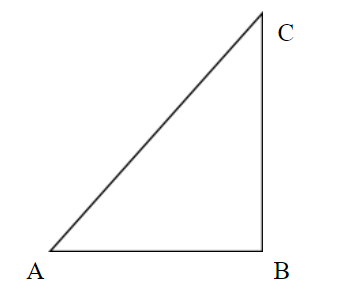
sin of ∠A = side opposite to angle A/hypotenuse = BC/AC
cos of ∠A = side adjacent to angle A/hypotenuse = AB/AC
tan of ∠A = side opposite to angle A/side adjacent to angle A = BC/AB
cot of ∠A = 1/tangent of angle A = AB/BC
sec of ∠A = 1/cosine of angle A = AC/AB
cosec of ∠A = 1/sine of angle A = AC/BC
Trigonometric Ratios for specific angles
Now, when it comes to specific angles in trigonometry, then these angles are generally defined as 0°, 30°, 45°, 60° and 90°. However, sometimes it is even extended to 180°, 270° and 360°. The trigonometric ratios for these specific angles are given in the form of a table, which is as follows:
| θ | 0° | 30° | 45° | 60° | 90° | 180° | 270° | 360° |
| sin θ | 0 | 12 | 12 | 32 | 1 | 0 | -1 | 0 |
| cos θ | 1 | 32 | 12 | 12 | 0 | -1 | 0 | 1 |
| tan θ | 0 | 13 | 1 | 3 | ∞ | 0 | ∞ | 0 |
| cot θ | ∞ | 3 | 1 | 13 | 0 | ∞ | 0 | ∞ |
| sec θ | 1 | 23 | 2 | 2 | ∞ | -1 | ∞ | 1 |
| cosec θ | ∞ | 2 | 2 | 23 | 1 | ∞ | -1 | ∞ |
Trigonometric Ratios for Complementary angles
When an angle is defined in the form of 90°-A, the sides of the triangle w.r.t the angle becomes opposite. That means:
- Normally, sin A = BC/AC. But the sides becomes opposite when the angle is subtracted from 90°, i.e. sin (90° -A) = AB/AC
- Similarly, cos A = AB/AC. So, cos (90° -A) = BC/AC
- Again, tan A = BC/AB. So, tan (90° -A) = AB/BC
- Again, cot A = AB/BC. So, cot (90° -A) = BC/AB
- Similarly, sec A = AC/AB. So, sec (90° -A) = AC/BC
- And, csc A = AC/BC. So, csc (90° -A) = AC/AB
Now, from these points, we can deduce the following:
- sin (90°-A) =cos A
- cos (90°-A) =sin A
- tan (90°-A) =cot A
- cot (90°-A) =tan A
- sec (90°-A) =csc A
- csc 90°-A =sec A
These are known as trigonometric ratios for complementary angles. However, these trigonometric ratios can be given for more complementary related angles. These ratios are defined in the following table:
| θ | -θ | 90° ± θ | 180° ± θ | 270° ± θ | 360° ± θ |
| sin | -sin θ | cos θ | sin θ | -cos θ | ±sin θ |
| cos | cos θ | sin θ | -cos θ | ±sin θ | cos θ |
| tan | -tan θ | cot θ | ±sin θ | cot θ | ±tan θ |
Continue your trigonometry learning with our next article on trigonometric identities and many more topics here.