Updated for May 2026
If you’re preparing for CUET, IPMAT, SET, or any entrance exam with a General Knowledge section — this list is one of those quiet score boosters. GK questions on important days and dates show up with surprising regularity, and they’re free marks if you’ve revised them even once.
Below is the complete list of important days in May 2026, with enough context for each one that you can actually remember them — not just read through them.
(Bookmark this page. Come back to it a week before your exam for a quick revision.)
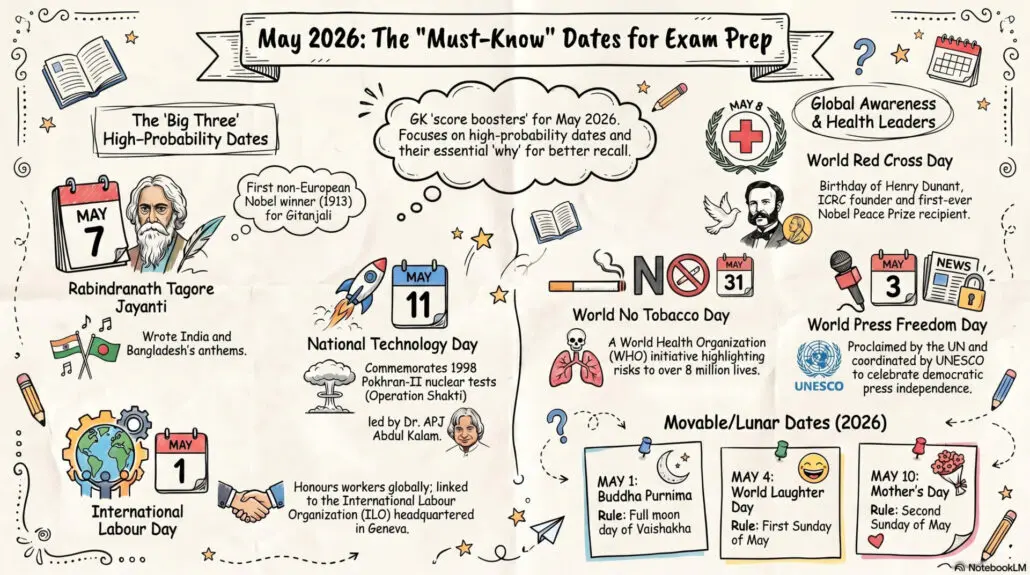
Quick Reference — Important Days in May 2026 at a Glance
| Date | Day |
|---|---|
| 1 May | International Labour Day / May Day |
| 1 May | Maharashtra Day |
| 1 May | Buddha Purnima (Vesak) |
| 3 May | World Press Freedom Day |
| 4 May | Coal Miners Day |
| 4 May | International Firefighters Day |
| 4 May (first Sunday) | World Laughter Day |
| 5 May (first Tuesday) | World Asthma Day |
| 7 May | World Athletics Day |
| 7 May | Rabindranath Tagore Jayanti |
| 8 May | World Red Cross Day |
| 8 May | World Thalassaemia Day |
| 10 May (second Sunday) | Mother’s Day |
| 11 May | National Technology Day |
| 12 May | International Nurses Day |
| 15 May | International Day of Families |
| 16 May | International Day of Light |
| 17 May | World Telecommunication Day |
| 17 May | World Hypertension Day |
| 18 May | World AIDS Vaccine Day |
| 18 May | International Museum Day |
| 20 May | World Bee Day |
| 21 May | National Anti-Terrorism Day |
| 21 May | International Tea Day |
| 22 May | International Day for Biological Diversity |
| 28 May | Veer Savarkar Jayanti |
| 31 May | World No Tobacco Day |
1 May — International Labour Day (May Day)
International Labour Day — also called May Day — is observed globally on 1 May every year. In India, it goes by Antarrashtriya Shramik Diwas or Kamgar Din. The day honours the contributions of workers and the labour movement. It traces its origins to the late 19th century labour protests in the United States, particularly the Haymarket affair in Chicago (1886).
For GK purposes, remember: the International Labour Organization (ILO) is the key body associated with workers’ rights globally, and it’s a UN agency headquartered in Geneva.
1 May — Maharashtra Day (Maharashtra Diwas)
Maharashtra Day marks the formation of the state of Maharashtra on 1 May 1960. Before this, the region was part of the bilingual Bombay State. The state was carved out along linguistic lines under the States Reorganisation Act, with Gujarat forming as a separate state on the same day (celebrated as Gujarat Day).
1 May — Buddha Purnima (Vesak) [2026]
In 2026, Buddha Purnima falls on 1 May — the full moon day of Vaishakha. This is the most sacred day in the Buddhist calendar, marking the birth, enlightenment, and death (parinirvana) of Gautama Buddha. It’s a gazetted holiday across India.
(This date changes every year since it follows the lunar calendar. For exam purposes, knowing that it falls on the Vaishakha Purnima is more useful than memorising the exact date.)
3 May — World Press Freedom Day
World Press Freedom Day was proclaimed by the UN General Assembly in 1993. The day serves as a reminder of the importance of a free and independent press in a democratic society. It also pays tribute to journalists who have lost their lives in the line of duty.
The key association for exam questions: UNESCO coordinates the global celebrations for this day.
4 May — Coal Miners Day
Coal Miners Day recognises the dangerous and physically demanding work that coal miners do. India is among the world’s largest coal producers, which makes this day especially relevant in an Indian context — questions linking Coal India Limited or India’s coal production to this observance aren’t uncommon.
4 May — International Firefighters Day
International Firefighters Day was first proposed on 4 January 1999 in Australia, following the deaths of five firefighters in a wildfire. It has been observed on 4 May since then, honouring firefighters who risk their lives for public safety.
First Sunday of May — World Laughter Day (4 May 2026)
This one started in India. Dr. Madan Kataria, the founder of the Laughter Yoga movement, organised the first World Laughter Day celebration in Mumbai on 10 May 1998. The day promotes the idea that laughter has real health benefits — reduced stress, improved immunity, and better mood.
(If this ever shows up as a GK question, “Dr. Madan Kataria” and “Mumbai” are the two facts worth remembering.)
First Tuesday of May — World Asthma Day (5 May 2026)
World Asthma Day is organised by the Global Initiative for Asthma (GINA) to raise awareness about asthma — a chronic respiratory condition that affects millions worldwide. The date moves every year since it falls on the first Tuesday of May.
7 May — World Athletics Day
World Athletics Day encourages young people to take up athletics as a sport. Schools and institutions around the world organise events on this day. It’s promoted by World Athletics (formerly the IAAF).
7 May — Rabindranath Tagore Jayanti
Rabindranath Tagore was born on 7 May 1861 in Calcutta (now Kolkata). He won the Nobel Prize in Literature in 1913 for Gitanjali — making him the first non-European to receive the Nobel Prize in Literature. He wrote India’s national anthem (Jana Gana Mana) and Bangladesh’s national anthem (Amar Sonar Bangla).
For exam prep, these are the high-probability facts: Nobel Prize year (1913), the work (Gitanjali), and the two national anthems. These show up across CUET, IPMAT, and SET with remarkable consistency.
8 May — World Red Cross Day
World Red Cross Day is observed on 8 May — the birthday of Henry Dunant, who founded the International Committee of the Red Cross (ICRC). Dunant was also the first-ever recipient of the Nobel Peace Prize (1901, shared with Frédéric Passy).
8 May — World Thalassaemia Day
World Thalassaemia Day raises awareness about thalassaemia — a genetic blood disorder where the body produces abnormal haemoglobin. It can be passed from parent to child. The day also honours caregivers who support people living with the condition.
Second Sunday of May — Mother’s Day (10 May 2026)
Mother’s Day is celebrated on the second Sunday of May every year. The modern version of the holiday was founded by Anna Jarvis in 1908 in the United States, and it became an official U.S. holiday in 1914. The day honours mothers and motherhood across cultures.
11 May — National Technology Day
National Technology Day commemorates 11 May 1998 — the day India conducted the Pokhran-II nuclear tests (Operation Shakti) under the leadership of Dr. APJ Abdul Kalam and R. Chidambaram. The same day also saw the successful test flight of the Hansa-3 aircraft and the first indigenous missile test.
This is one of the more frequently tested dates in Indian GK — the connection between 11 May, Pokhran-II, and Dr. Kalam comes up often.
12 May — International Nurses Day
International Nurses Day is celebrated on 12 May — the birth anniversary of Florence Nightingale, who is regarded as the founder of modern nursing. The International Council of Nurses (ICN) releases a themed kit every year to support healthcare education on this day.
15 May — International Day of Families
The International Day of Families was proclaimed by the UN General Assembly in 1993 (resolution A/RES/47/237). It highlights the importance of families as fundamental units of society and raises awareness about social, economic, and demographic issues that affect them.
16 May — International Day of Light
The International Day of Light is a UNESCO initiative celebrated on 16 May each year. The date marks the anniversary of the first successful operation of the laser in 1960 by physicist Theodore Maiman. The day promotes awareness of how light-based technologies contribute to science, culture, art, education, and sustainable development.
17 May — World Telecommunication and Information Society Day
This day marks the founding of the International Telecommunication Union (ITU) on 17 May 1865, when the first International Telegraph Convention was signed in Paris. It promotes awareness about how the internet and information and communication technologies (ICTs) can bridge the digital divide.
17 May — World Hypertension Day
World Hypertension Day is led by the World Hypertension League (WHL). Hypertension — sustained high blood pressure — is one of the leading risk factors for heart disease and stroke globally. The day educates people about prevention through diet, exercise, and regular health check-ups.
18 May — World AIDS Vaccine Day (HIV Vaccine Awareness Day)
World AIDS Vaccine Day recognises the work of researchers and health professionals working towards an effective HIV vaccine. The day was first observed on 18 May 1998, inspired by a speech by then-US President Bill Clinton calling for the development of an AIDS vaccine.
18 May — International Museum Day
International Museum Day has been observed on 18 May every year since 1977, when it was established by the International Council of Museums (ICOM). Museums worldwide organise special events and exhibitions around a different theme each year — past themes have covered globalisation, sustainability, and bridging cultural gaps.
20 May — World Bee Day
World Bee Day highlights the role of bees and other pollinators in ecosystems and food production. The date — 20 May — was chosen to honour the birthday of Anton Janša, a pioneer of modern beekeeping from Slovenia. The UN designated this day in 2017.
(This is a relatively newer observance, so it’s worth noting for current affairs sections of your exams.)
21 May — National Anti-Terrorism Day
National Anti-Terrorism Day is observed in India on 21 May — the anniversary of the assassination of former Prime Minister Rajiv Gandhi in 1991. The day promotes awareness about the human cost of terrorism and the importance of national unity against violence.
21 May — International Tea Day
International Tea Day was established by the UN General Assembly in 2019 and is observed on 21 May. Given that India is one of the world’s largest tea producers (Assam and Darjeeling being globally recognised tea regions), this day has particular relevance for Indian GK sections.
22 May — International Day for Biological Diversity
This UN-designated day promotes understanding and awareness of biodiversity — the variety of life on Earth — and the threats posed to it by human activities like deforestation, pollution, and climate change. The date was shifted to 22 May in 2000 to commemorate the adoption of the Convention on Biological Diversity.
28 May — Veer Savarkar Jayanti
Veer Savarkar Jayanti marks the birth anniversary of Vinayak Damodar Savarkar (born 28 May 1883). He was a freedom fighter, political thinker, and writer who developed the concept of Hindutva. He was imprisoned in the Cellular Jail in the Andaman Islands during British rule. [VERIFY: confirm this date appears in current exam syllabi for your target exams]
31 May — World No Tobacco Day
World No Tobacco Day is observed by the World Health Organization (WHO) on 31 May every year. The day draws attention to the health risks of tobacco use — tobacco causes over 8 million deaths annually worldwide. Each year, WHO selects a specific theme to focus the campaign.
How to Use This List for Exam Preparation
Memorising dates alone doesn’t help much if you forget the context behind them. A more effective approach: read through this list once carefully, then quiz yourself on the associations. For example — which day is linked to Henry Dunant? What happened on 11 May 1998? Which day was started by Dr. Madan Kataria in Mumbai?
The dates that show up most often in BBA and IPM entrance exams are National Technology Day, Rabindranath Tagore Jayanti, World Red Cross Day, and International Labour Day. If you’re short on time, prioritise those.
You can also practice with our GK practice quizzes — we include important days questions in the rotation.
Frequently Asked Questions
How many important days are observed in May?
May has over 25 nationally and internationally recognised observances, ranging from International Labour Day on 1 May to World No Tobacco Day on 31 May. The exact number varies slightly depending on which observances you include.
Is Buddha Purnima always in May?
Not always. Buddha Purnima falls on the full moon day of Vaishakha, which can land in either April or May depending on the lunar calendar. In 2026, it falls on 1 May.
Why is 11 May celebrated as National Technology Day in India?
11 May marks the date of the Pokhran-II nuclear tests in 1998 (Operation Shakti). India successfully conducted five nuclear tests at Pokhran, Rajasthan, making it the country’s second nuclear test after Pokhran-I in 1974.
Which important days in May are most relevant for CUET and IPMAT preparation?
For entrance exams, focus on National Technology Day (11 May), Rabindranath Tagore Jayanti (7 May), World Red Cross Day (8 May), International Labour Day (1 May), and World No Tobacco Day (31 May). These appear most frequently in GK sections.
What is the significance of 21 May in India?
21 May is observed as National Anti-Terrorism Day in India, marking the assassination of former PM Rajiv Gandhi in 1991. It is also International Tea Day, a UN-designated observance.
When is World Bee Day and why was 20 May chosen?
World Bee Day is observed on 20 May — the birthday of Anton Janša, a Slovenian pioneer of modern beekeeping. The UN designated this day in 2017 to raise awareness about the importance of pollinators.
Your next move: head to our Daily GK Quiz and test how many of these you can recall without looking. That one round of active recall will do more than reading this list three times.
P.S. We update this page every year with the latest dates for movable observances like Buddha Purnima, Mother’s Day, World Laughter Day, and World Asthma Day. Bookmark it and check back before exam season.
So there you have it, the list of Important Days In May. Don’t forget to check out the list of Important Days in other months at Eazyprep!
More GK & Current Affairs Resources:
- Attempt today’s Daily GK Quiz
- Read today’s Daily Current Affairs Update
- Attempt topicwise General Knowledge Practice Quiz
- Download Monthly Current Affairs Compilations
- Read about this month’s Important Days
- Revise your General Knowledge with Weekly GK Revision Quiz