Updated for 2026
February may be the shortest month, but it carries its share of important dates for your GK section — from globally observed health awareness days to key Indian political and cultural anniversaries.
If you’re revising for CUET, IPMAT, SET, or CLAT — scan the quick reference table below, then read through the entries that are new to you. For the ones you already know, just confirm the key facts are locked in.
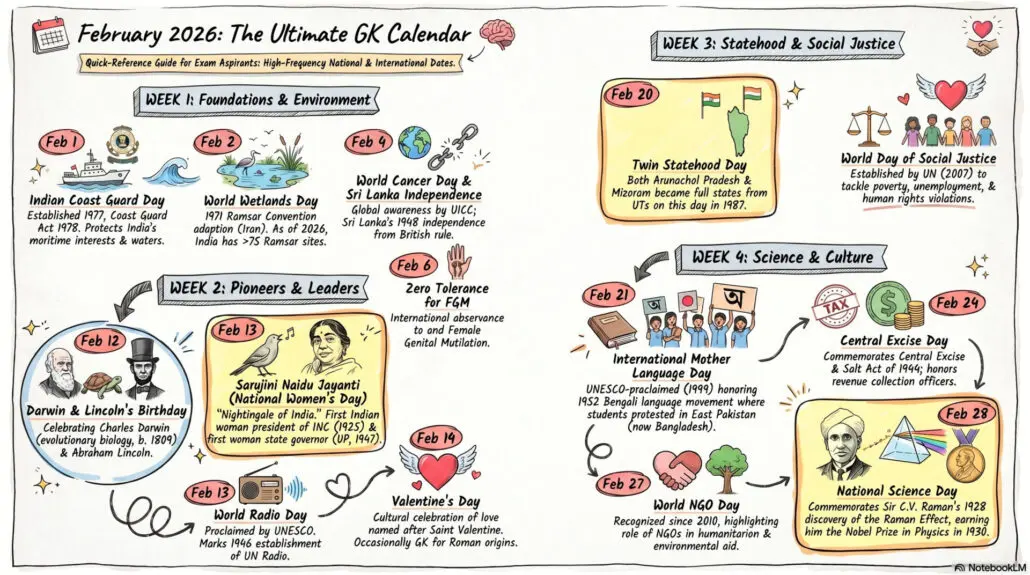
Quick Reference — Important Days in February 2026
| Date | Day |
|---|---|
| 1-7 February | Indian Coast Guard Day (1 Feb) / International Development Week |
| 2 February | World Wetlands Day |
| 4 February | World Cancer Day |
| 4 February | Sri Lanka Independence Day |
| 6 February | International Day of Zero Tolerance for Female Genital Mutilation |
| 12 February | Darwin Day (Charles Darwin’s Birthday) |
| 12 February | Abraham Lincoln’s Birthday |
| 13 February | Sarojini Naidu Jayanti (National Women’s Day) |
| 13 February | World Radio Day |
| 14 February | Valentine’s Day |
| 20 February | Arunachal Pradesh Statehood Day |
| 20 February | World Day of Social Justice |
| 21 February | International Mother Language Day |
| 24 February | Central Excise Day |
| 27 February | World NGO Day |
| 28 February | National Science Day |
1 February — Indian Coast Guard Day
The Indian Coast Guard was established on 1 February 1977 under the Coast Guard Act passed by Parliament in 1978. It’s an armed force responsible for protecting India’s maritime interests and enforcing laws in territorial waters.
2 February — World Wetlands Day
World Wetlands Day marks the adoption of the Convention on Wetlands on 2 February 1971 in Ramsar, Iran — which is why the treaty is called the Ramsar Convention. India has over 75 Ramsar sites as of 2026 [VERIFY current count], making the Ramsar Convention a frequently tested GK topic.
4 February — World Cancer Day
World Cancer Day is led by the Union for International Cancer Control (UICC). The day raises awareness about cancer prevention, detection, and treatment. WHO selects a theme each year for the campaign.
4 February — Sri Lanka Independence Day
Sri Lanka gained independence from British rule on 4 February 1948. This is occasionally asked in “countries and their independence dates” type questions.

12 February — Darwin Day
Charles Darwin, the father of evolutionary biology, was born on 12 February 1809. His work On the Origin of Species (1859) introduced the theory of evolution by natural selection.
13 February — Sarojini Naidu Jayanti / National Women’s Day
Sarojini Naidu (born 13 February 1879 in Hyderabad) was known as the “Nightingale of India.” She was the first Indian woman to become president of the Indian National Congress (1925) and the first woman governor of an Indian state (Uttar Pradesh, 1947).
For exams, the three key facts are: Nightingale of India, first woman INC president, first woman governor of a state.
13 February — World Radio Day
UNESCO proclaimed 13 February as World Radio Day to celebrate radio as a medium of communication and information. The date marks the establishment of United Nations Radio in 1946.
14 February — Valentine’s Day
Valentine’s Day is named after Saint Valentine, a Catholic priest in Rome. While primarily known as a cultural celebration of love, this date occasionally appears in GK sections in the context of its historical origins.
20 February — Arunachal Pradesh Statehood Day
Arunachal Pradesh became a full state on 20 February 1987. It was previously a Union Territory. Mizoram also gained statehood on the same date in 1987 — this twin-statehood fact is a common exam question.
20 February — World Day of Social Justice
Established by the UN General Assembly in 2007, this day promotes efforts to tackle issues like poverty, social exclusion, unemployment, and human rights violations.
21 February — International Mother Language Day
International Mother Language Day was proclaimed by UNESCO in 1999 to promote linguistic and cultural diversity. The date honours the Bengali language movement in Bangladesh (then East Pakistan) in 1952, when students protested for the recognition of Bengali as a state language and several were killed.
(This is a high-frequency question — UNESCO, 1999, and the Bangladesh/Bengali language movement connection.)
24 February — Central Excise Day
Central Excise Day marks the enactment of the Central Excise and Salt Act in 1944. The day honours officers of the Central Board of Indirect Taxes and Customs (CBIC) for their contribution to revenue collection.
27 February — World NGO Day
World NGO Day, observed since 2010, recognises the role of non-governmental organisations in addressing global challenges including humanitarian aid, education, healthcare, and environmental protection.
28 February — National Science Day
National Science Day commemorates the discovery of the Raman Effect by Sir C.V. Raman on 28 February 1928. Raman won the Nobel Prize in Physics in 1930 for this discovery, making him the first Asian to receive a Nobel Prize in any branch of science.
This is one of the most tested dates in February. The key facts: C.V. Raman, Raman Effect, 1928 discovery, 1930 Nobel Prize in Physics.
So there you have it, the list of Important Days In February. Don’t forget to check out the list of Important Days in other months at Eazyprep!
Frequently Asked Questions
What is the Raman Effect, and why does it matter for GK?
The Raman Effect describes the change in wavelength of light when it’s scattered by molecules. For exam purposes, you don’t need to understand the physics — just the association: C.V. Raman discovered it on 28 February 1928 and won the Nobel Prize in Physics in 1930.
Why is 21 February observed as International Mother Language Day?
It honours the 1952 Bengali language movement in what was then East Pakistan (now Bangladesh). Students were killed while protesting for Bengali to be recognised as a state language. UNESCO designated the day in 1999.
Which two states gained statehood on 20 February 1987?
Arunachal Pradesh and Mizoram both became full states on 20 February 1987. This twin-statehood fact is a common exam question.
Your next move: make sure you have the C.V. Raman — Raman Effect — 1928 — Nobel 1930 chain memorised. It’s one of the safest GK bets across entrance exams.
P.S. For a month-by-month revision, check out our Important Days hub page. And try the Daily GK Quiz to test what you remember.
More GK & Current Affairs Resources:
- Attempt today’s Daily GK Quiz
- Read today’s Daily Current Affairs Update
- Attempt topicwise General Knowledge Practice Quiz
- Download Monthly Current Affairs Compilations
- Read about this month’s Important Days
- Revise your General Knowledge with Weekly GK Revision Quiz