Updated for 2026
January sets the tone for the year — and for your GK preparation. Between Republic Day, National Youth Day, and several internationally recognised observances, this month is packed with dates that show up in entrance exam GK sections year after year.
If you’re preparing for CUET, IPMAT, SET, CLAT, or any exam with a General Awareness component — this list covers what you need to know, with enough context to actually remember each one.
(Bookmark this and come back to it before your exam. One focused revision pass through this page is worth more than three passive reads.)
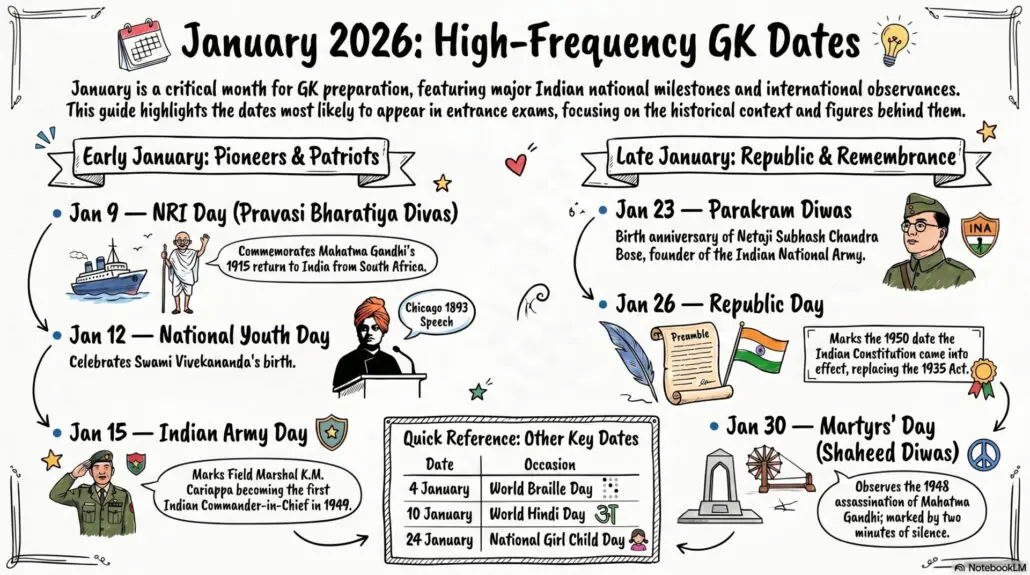
Quick Reference — Important Days in January 2026
| Date | Day |
|---|---|
| 1 January | Global Family Day |
| 4 January | World Braille Day |
| 9 January | NRI Day (Pravasi Bharatiya Divas) |
| 10 January | World Hindi Day |
| 11 January | Death Anniversary of Lal Bahadur Shastri |
| 12 January | National Youth Day (Swami Vivekananda Jayanti) |
| 15 January | Indian Army Day |
| 23 January | Netaji Subhash Chandra Bose Jayanti (Parakram Diwas) |
| 24 January | National Girl Child Day |
| 25 January | National Voters Day |
| 25 January | National Tourism Day |
| 26 January | Republic Day |
| 26 January | International Customs Day |
| 27 January | International Holocaust Remembrance Day |
| 28 January | Birth Anniversary of Lala Lajpat Rai |
| 30 January | Martyrs’ Day (Shaheed Diwas) |
| 30 January | World Leprosy Eradication Day |
1 January — Global Family Day
Global Family Day promotes the idea of peace, unity, and the principle of “Vasudhaiv Kutumbakam” — the whole world is one family. It’s a day to reflect on global togetherness and our shared responsibility towards each other.
4 January — World Braille Day
World Braille Day marks the birth anniversary of Louis Braille (born 4 January 1809), the inventor of the Braille reading and writing system used by visually impaired people worldwide. The UN General Assembly established this observance in 2018.
9 January — NRI Day / Pravasi Bharatiya Divas
Pravasi Bharatiya Divas honours the contributions of the Indian diaspora to India’s development. The date — 9 January — commemorates Mahatma Gandhi’s return to India from South Africa in 1915. Gandhi is sometimes called the first Pravasi Bharatiya.
(For exam purposes, the Gandhi-South Africa-1915 connection is the key fact here.)
10 January — World Hindi Day (Vishwa Hindi Diwas)
World Hindi Day marks the anniversary of the first World Hindi Conference held in Nagpur in 1975. Don’t confuse this with Hindi Diwas on 14 September, which celebrates the adoption of Hindi as an official language of India.
11 January — Death Anniversary of Lal Bahadur Shastri
India’s second Prime Minister, Lal Bahadur Shastri, passed away on this date in 1966 in Tashkent, Uzbekistan. He is remembered for the slogan “Jai Jawan Jai Kisan” (Hail the Soldier, Hail the Farmer) and for his role during the 1965 Indo-Pak War.

12 January — National Youth Day (Swami Vivekananda Jayanti)
National Youth Day celebrates the birth anniversary of Swami Vivekananda (born 12 January 1863). His famous speech at the Parliament of World Religions in Chicago in 1893 — opening with “Sisters and brothers of America” — remains one of the most quoted speeches in Indian history.
This is one of the most frequently tested dates in entrance exams. Remember: Vivekananda, 1863, Chicago 1893, and the founding of the Ramakrishna Mission.
15 January — Indian Army Day
Indian Army Day marks the day Field Marshal K.M. Cariappa took over as the first Indian Commander-in-Chief of the Indian Army on 15 January 1949, succeeding the last British Commander-in-Chief, General Sir Francis Butcher.
23 January — Netaji Subhash Chandra Bose Jayanti (Parakram Diwas)
Netaji Subhash Chandra Bose was born on 23 January 1897. He founded the Indian National Army (Azad Hind Fauj) and is remembered for the rallying cry “Tum mujhe khoon do, main tumhe azadi doonga.” Since 2021, this day is also officially observed as Parakram Diwas (Day of Valour).
24 January — National Girl Child Day
National Girl Child Day was initiated by the Ministry of Women and Child Development in 2008. It raises awareness about gender-based inequalities in India — focusing on girls’ education, nutrition, legal rights, and healthcare access.
25 January — National Voters Day
National Voters Day has been celebrated since 2011 on 25 January — the foundation day of the Election Commission of India (established in 1950). The day encourages young voters to participate in the democratic process.
25 January — National Tourism Day
National Tourism Day promotes awareness about the role of tourism in India’s economy. India’s tourism sector is a significant contributor to GDP and employment, and this day highlights the country’s cultural and geographic diversity as a travel destination.
26 January — Republic Day
The Constitution of India came into effect on 26 January 1950, replacing the Government of India Act 1935 as the governing document. The date was chosen because the Indian National Congress declared Purna Swaraj (complete independence) on 26 January 1930.
This is the single most important date in January for GK purposes. Key facts: Constitution adopted 26 November 1949, came into effect 26 January 1950, Dr. B.R. Ambedkar chaired the Drafting Committee.
26 January — International Customs Day
International Customs Day is observed by the World Customs Organization (WCO) to recognise the role of customs officials in maintaining border security, facilitating trade, and preventing smuggling.

27 January — International Holocaust Remembrance Day
This UN-designated day marks the anniversary of the liberation of the Auschwitz-Birkenau concentration camp in 1945. It honours the memory of the six million Jewish victims of the Holocaust and millions of others who suffered under Nazi persecution.
28 January — Birth Anniversary of Lala Lajpat Rai
Lala Lajpat Rai (born 28 January 1865) was known as the “Lion of Punjab” and “Punjab Kesari.” He was part of the Lal-Bal-Pal trio (with Bal Gangadhar Tilak and Bipin Chandra Pal) and played a role in founding the Punjab National Bank. He died in 1928 from injuries sustained during a lathi charge while protesting the Simon Commission.
30 January — Martyrs’ Day (Shaheed Diwas)
Martyrs’ Day marks the assassination of Mahatma Gandhi on 30 January 1948 by Nathuram Godse. A two-minute silence is observed across India at 11 AM on this day. The day also honours other freedom fighters who sacrificed their lives, including Bhagat Singh, Sukhdev Thapar, and Shivaram Rajguru (martyred on 23 March 1931).
(Note: 23 March is also observed as Shaheed Diwas — specifically for Bhagat Singh, Sukhdev, and Rajguru. Don’t confuse the two dates.)
30 January — World Leprosy Eradication Day
Observed on the last Sunday of January (sometimes listed as 30 January), this day raises awareness about leprosy — a chronic infectious disease caused by Mycobacterium leprae — and the ongoing efforts to eliminate it globally. [VERIFY: exact 2026 date — last Sunday of January 2026 falls on 25 January]
Frequently Asked Questions
Which important days in January are most frequently tested in entrance exams?
Republic Day (26 January), National Youth Day (12 January), Indian Army Day (15 January), and Netaji Subhash Chandra Bose Jayanti (23 January) are the most commonly tested. The associated facts — Swami Vivekananda’s Chicago speech, K.M. Cariappa as first Indian Army chief, and the Constitution’s effective date — are high-probability GK questions.
What is the difference between National Youth Day and International Youth Day?
National Youth Day is on 12 January (Swami Vivekananda’s birthday) and is specific to India. International Youth Day is on 12 August and is a UN-designated global observance. Both are testable.
Why is 26 January chosen as Republic Day instead of 15 August?
15 August 1947 is Independence Day — when India gained independence from British rule. 26 January 1950 is Republic Day — when the Constitution came into effect and India became a republic. The date 26 January was specifically chosen because the INC had declared Purna Swaraj on that date in 1930.
So there you have it, the list of Important Days In January. Don’t forget to check out the list of Important Days in other months at Eazyprep!
Your next move: test yourself on the five most important dates from this list without looking. If you can recall the associated facts for Republic Day, National Youth Day, Army Day, Netaji Jayanti, and Martyrs’ Day — you’ve covered the highest-frequency questions.
P.S. Check out the Important Days in February to continue building your revision list. And if you want to practice, our GK Practice Quiz includes important days questions in the rotation.
More GK & Current Affairs Resources:
- Attempt today’s Daily GK Quiz
- Read today’s Daily Current Affairs Update
- Attempt topicwise General Knowledge Practice Quiz
- Download Monthly Current Affairs Compilations
- Read about this month’s Important Days
- Revise your General Knowledge with Weekly GK Revision Quiz